📋 In This Guide
- Why Awnings Matter for Melbourne Cafés & Restaurants
- Commercial vs. Residential Awnings: Key Differences
- Compliance & Building Regulations in Victoria
- Council Approval Timeline & Compliance Pathway
- Design & Branding Your Awning
- Material & Structural Requirements
- Motorised vs. Manual Operation
- Durability, Maintenance & Care
- Safety & Liability Considerations
- Strata & Shared Space Considerations
- Budget, ROI & Long-Term Value
- Interactive Awning Selector Tool
- Installation Process & Timeline
- Frequently Asked Questions
Why Awnings Matter for Melbourne Cafés & Restaurants
Melbourne’s café culture is among the most competitive and discerning in Australia. From the laneways of Fitzroy and Collingwood to the beachside strips of St Kilda and Brighton, outdoor dining is not a luxury — it is an expectation. The challenge every venue owner faces is Melbourne’s notorious weather variability: brilliant sunshine, blustery southerly winds, sudden summer downpours, and intense UV exposure can turn a vibrant alfresco section into an empty one within minutes.
A well-specified commercial awning resolves that tension immediately. It extends your usable outdoor area across more days of the year, signals quality and professionalism to passing foot traffic, and creates a clearly defined, comfortable environment that keeps customers seated longer. Research from the Australian Outdoor Living Council consistently shows that venues with covered alfresco areas generate meaningfully higher table turns and average spend per visit compared to uncovered equivalents — particularly during shoulder seasons when Melbourne’s weather is at its most unpredictable.
But choosing the right awning for a commercial venue in Victoria is categorically different from selecting one for a residential pergola. The compliance requirements are stricter, the structural demands are higher, the operational context is more demanding, and the branding opportunity is significantly greater. This guide walks Melbourne café and restaurant owners through every dimension of that decision.
*Source: Australian Outdoor Living Council industry data. Figures are indicative; venue-specific results vary.
Commercial vs. Residential Awnings: Key Differences
One of the most common mistakes Melbourne venue owners make is approaching a commercial awning project with the same expectations as a home installation. The differences are substantial — and getting them wrong can result in failed inspections, liability exposure, or an awning that simply isn’t durable enough to survive a busy Friday night service in Prahran.
| Consideration | Residential Awning | Commercial Awning |
|---|---|---|
| Planning & Permits | Often exempt under small structures provisions | Planning permit and/or building permit typically required |
| Structural Engineering | Rarely required | Engineer certification commonly required for fixings and loads |
| Fire Rating | Not typically assessed | Fabrics must meet fire spread and ignitability standards under NCC 2022 |
| Wind Load | Standard regional classification | Higher load factors applied; site-specific assessment often needed |
| Operational Frequency | Occasional use | Daily, high-frequency use — requires commercial-grade components |
| Branding & Signage | Not relevant | Subject to local signage regulations — separate permit may be needed |
| Public Liability | Homeowner’s policy | Must be factored into public liability insurance for venue operators |
| Footpath Projection | Not applicable | Governed by local council road and footpath occupation policies |
| Warranty Expectations | 5–10 years standard | Commercial-grade warranty; component-level service agreements |
At Retractable Pergola Systems Victoria, we work exclusively with commercial-grade products and have extensive experience navigating Victoria’s compliance landscape. Our folding arm awning range and motorised awning systems are specified and installed to meet the demands of Melbourne’s commercial venue environment.
Compliance & Building Regulations for Café & Restaurant Awnings in Victoria
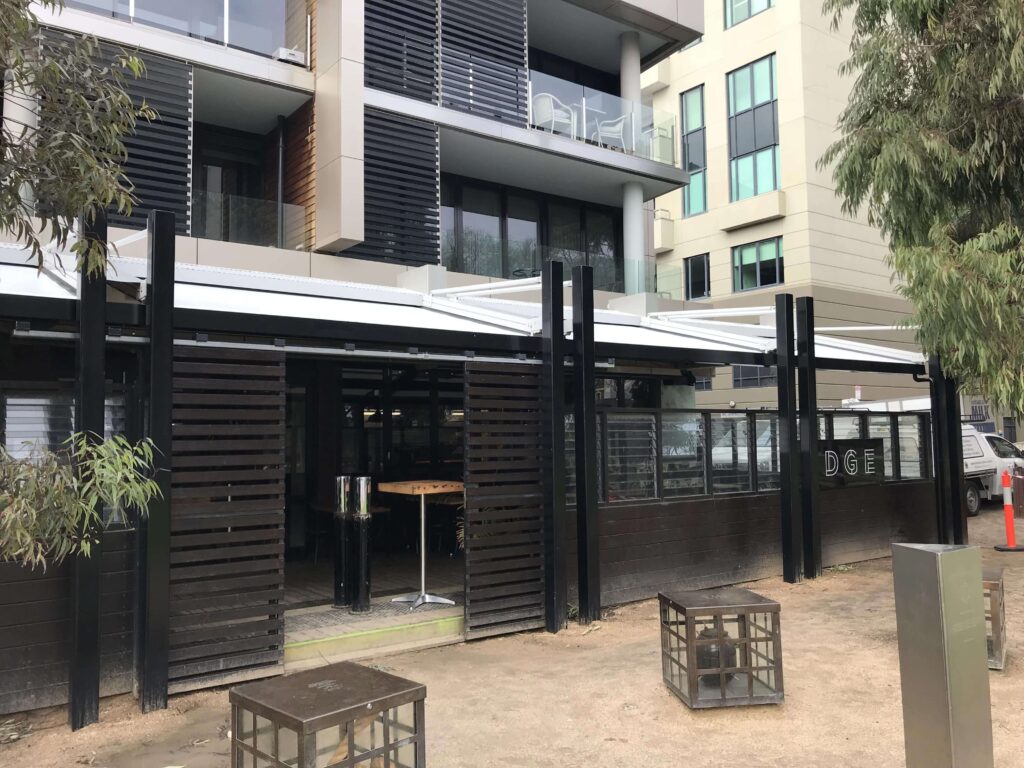
Commercial retractable awning installation — structural compliance and clearance heights are critical for Melbourne venues
Navigating Victoria’s regulatory framework is often the most daunting part of a commercial awning project. The good news is that with the right guidance and an experienced installer, compliance is a clearly defined and entirely manageable process. Here is what Melbourne café and restaurant owners need to understand as of May 2026.
The National Construction Code (NCC 2022)
Australia’s building framework is governed by the National Construction Code (NCC 2022), which Victoria adopted in full via the Building Act 1993 (Vic) and the Building Regulations 2018 (Vic). Commercial awnings attached to or projecting from a Class 6 building (which includes cafés and restaurants) are assessed as building work and must comply with the NCC’s structural, fire, and safety performance requirements.
Planning Permits Under the Planning and Environment Act 1987
Whether a planning permit is required depends on your property’s planning zone and overlay under your local council’s planning scheme. Common triggers include:
- Awnings projecting over public land or footpaths
- Properties within Heritage Overlays (common in Carlton, Fitzroy, South Yarra, and other inner-city suburbs)
- Buildings within Design and Development Overlays
- Awnings exceeding certain dimensions specified in local planning policies
- Any signage or branding incorporated into the awning structure
Building Permits and Structural Certification
Beyond planning, a building permit issued by a Registered Building Surveyor is typically required for commercial awnings that are structurally fixed to a building. This permit process involves:
- Structural engineering drawings signed by a registered engineer
- Evidence that the fixing substrate (wall, fascia, or structure) can bear the imposed loads
- Wind load calculations consistent with AS 1170.2 for Melbourne’s regional wind classification
- Compliance with fire spread requirements where fabric is within a certain proximity to adjacent buildings
- Mandatory inspection stages during and after installation
Australian Standards Applicable to Commercial Awnings
AS 1170.2 — Wind Actions
Structural wind load standard applied to all awning installations. Melbourne’s bayside locations (Port Melbourne, St Kilda, Brighton) require higher wind load ratings than inner-suburban venues.
NCC Vol 1 — Fire Performance
Commercial building fabric must meet ignitability and fire spread criteria under the NCC. Solution-dyed acrylic and certain coated PVC fabrics are compliant; standard residential-grade fabrics may not be.
AS 3959 — Construction in Bushfire Prone Areas
Venues in fringe Melbourne suburbs with a Bushfire Management Overlay face additional material and construction requirements under AS 3959.
AS 1428 — Disability Access
Awning structures and their support posts must not obstruct accessible pathways. Minimum clearance and tactile indicator requirements apply where supports are installed on pedestrian paths.
Council Approval Timeline & Compliance Pathway
Understanding the typical approval timeline helps Melbourne venue owners plan their outdoor space project realistically. Rushing the compliance process is the single most common cause of installation delays, unexpected costs, and regulatory complications.
Pre-Application Consultation (1–3 weeks)
Contact your local council’s planning department for a pre-application meeting. This free service (available from most Melbourne metropolitan councils) identifies applicable zones, overlays, and permit triggers before you incur design or engineering costs. Highly recommended for heritage-affected sites.
Design Development & Engineering (2–4 weeks)
Work with your awning specialist and, where required, a structural engineer to develop compliant design drawings. This stage defines dimensions, projection distances, clearance heights, fixing methodology, and fabric specifications.
Planning Permit Application (60–90 days average)
Lodge your planning permit application with the relevant council. Standard Victorian processing times are 60 days for straightforward applications; heritage-affected applications or those requiring advertising may extend to 90–120 days. Some councils — including Yarra, Port Phillip, and Stonnington — have dedicated fast-track streams for minor commercial works.
Building Permit (2–4 weeks)
Once planning approval is granted (or if no planning permit is required), engage a Registered Building Surveyor to issue the building permit. This stage involves structural document review and may include a mandatory inspection notice for the completed installation.
Installation & Occupancy (1–2 days installation)
Your commercial awning installer completes the installation to the approved drawings. A final inspection by the Building Surveyor confirms compliance before the awning is placed in service.
- City of Melbourne: melbourne.vic.gov.au — (03) 9658 9658
- City of Yarra (Fitzroy, Collingwood, Richmond): yarracity.vic.gov.au
- City of Port Phillip (St Kilda, South Melbourne): portphillip.vic.gov.au
- City of Stonnington (Prahran, South Yarra): stonnington.vic.gov.au
Design & Branding Your Awning: Creating the Right First Impression
For Melbourne café and restaurant owners, a commercial awning is far more than a weather solution — it is the most visible element of your venue’s streetscape identity. Before a customer reads your menu board or smells your coffee, they respond to your awning: its colour, its shape, its quality, and the way it frames your entrance.
The most effective commercial awnings in Melbourne do three things simultaneously: they protect, they brand, and they invite. Think of the bold canopy awnings on Brunswick Street in Fitzroy, the sleek retractable systems above Acland Street’s café strip in St Kilda, or the refined fabric awnings over South Yarra’s restaurant row on Toorak Road. In every case, the awning communicates something specific about the venue before a single word is spoken.
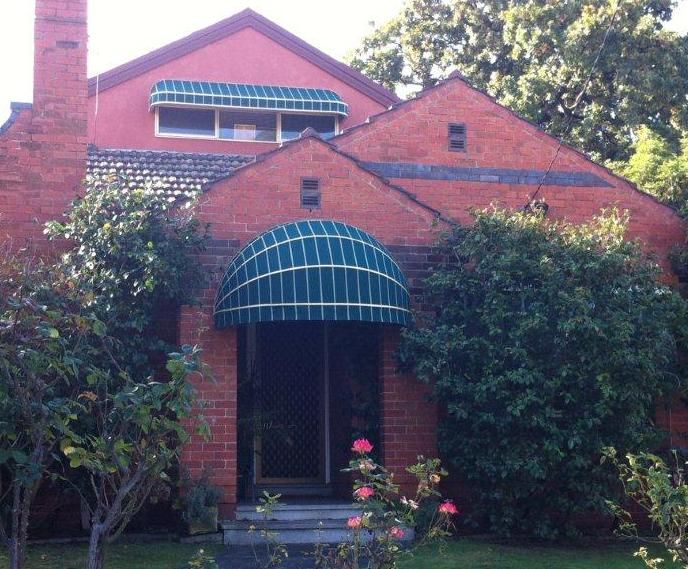
Awning Styles for Commercial Venues
Canopy Awnings
Fixed projecting canopies that create a strong architectural statement. Ideal for entrance canopies, door awnings, and venues where a permanent, structured look supports the brand. Available in a wide range of fabric colours and frame finishes. Explore our canopy awning range.
Folding Arm Awnings
Retractable systems offering maximum flexibility — extend when needed, retract when not. The commercial favourite for alfresco dining areas. Our folding arm awning systems accommodate spans suited to Melbourne’s typical commercial façades.
Drop Arm Awnings
Vertical drop screens that provide sun control and wind protection at the sides of alfresco areas. Frequently paired with folding arm systems for full enclosure. See our drop arm awning options.
Retractable Pergola Systems
For venues with larger alfresco areas requiring overhead coverage, retractable roof and pergola systems offer premium protection with architectural presence. Browse our retractable pergola systems.
Branding, Printing & Signage Considerations
Custom-printed awning fabrics allow Melbourne venues to integrate logos, brand colours, and design motifs directly into the structure. Digital printing on acrylic and polyester fabrics delivers sharp results with excellent UV fade resistance — critical in Melbourne’s harsh summer sun. However, there is an important regulatory consideration: where an awning incorporates business name, logo, or promotional content, it may be defined as a sign under your council’s planning scheme and subject to separate signage permit requirements. Confirm this with your local planning officer before committing to a branded design.
Material & Structural Requirements for Commercial Installations
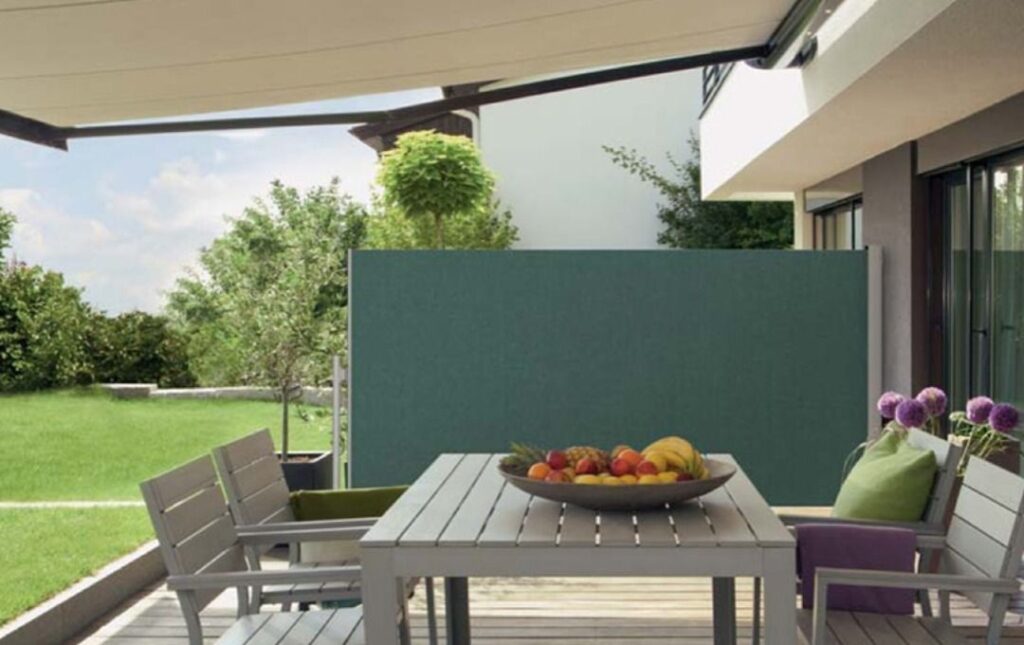
Commercial awning fabric and powder-coated aluminium framing — the foundation of a compliant, long-lasting installation
Fabric Selection
The fabric is the single most consequential material decision in a commercial awning specification. For Melbourne café and restaurant environments, the industry standard is solution-dyed acrylic — fabric where colour is woven into the fibre at the manufacturing stage rather than applied as a surface coating. This delivers:
- Exceptional UV resistance — colour stability rated for 10+ years of direct sun exposure
- Breathability — water-resistant while allowing moisture vapour to escape, preventing condensation pooling
- Mould and mildew resistance — critical in Melbourne’s variable humidity environment
- NCC fire performance compliance — solution-dyed acrylics from leading manufacturers such as Sunbrella and Dickson meet Group 3 classification under the NCC
- Wide colour range — hundreds of colours available for precise brand matching
Frame and Structural Components
Commercial awning frames must be specified in marine-grade powder-coated aluminium or, for coastal venues in Brighton, Port Melbourne, and Williamstown, 316-grade stainless steel hardware to resist salt air corrosion. Steel frames, while structurally robust, carry higher corrosion risk without premium protective coatings and add unnecessary weight to wall fixings. Aluminium’s strength-to-weight ratio makes it the preferred commercial structural material across Melbourne’s venue market.
Fixing Methodology
Adequate fixings are where residential and commercial installations diverge most critically. Commercial awnings in Melbourne must be fixed into structural elements — masonry, concrete, or primary steel — not into lightweight cladding, fascias, or heritage brickwork without appropriate engineering analysis. A structural engineer’s sign-off on the fixing substrate is not optional when public liability and building compliance are at stake.
Motorised vs. Manual: Operation & Control Options for Commercial Venues
For café and restaurant operators in Melbourne, the question of motorised versus manual awning operation has a straightforward answer in most commercial contexts: motorised wins. The reasons are practical, operational, and financial.
| Feature | Manual Operation | Motorised Operation |
|---|---|---|
| Operating effort during service | ✗ Requires staff attention | ✔ One-touch or automated |
| Wind sensor integration | ✗ Not available | ✔ Automatic retraction on wind alert |
| Rain sensor integration | ✗ Not available | ✔ Automatic retraction on rain detection |
| Sun/timer scheduling | ✗ Not available | ✔ Programmable schedules via smart controller |
| Wear from daily use | Higher — manual crank stress on components | ✔ Lower — smooth motor-driven extension |
| Initial investment | ✔ Lower upfront cost | Higher upfront investment |
| Operational ROI | Lower — staff time, wear costs | ✔ Higher — reduced labour, extended component life |
| Suitability for commercial use | Suitable for lower-frequency use | ✔ Recommended for all high-traffic commercial venues |
Explore our full retractable awning motorisation systems, including Somfy motor integration with wind and sun sensor packages specifically configured for Melbourne’s commercial venue environment.
Durability, Maintenance & Care for High-Traffic Commercial Venues
A commercial awning in a busy Melbourne café or restaurant will open and close hundreds of times per year. It will face UV radiation, salt-laden coastal air, summer downpours, hail events, and the occasional alfresco dining incident. Specifying a genuinely commercial-grade product from the outset is the only way to achieve the 12–18 year service life that justifies the investment.
Maintenance Schedule for Commercial Awnings
Monthly
Visual inspection of fabric for tears, abrasion, or stitching deterioration. Check that the awning operates smoothly — any grinding or resistance in the mechanism should be investigated immediately.
Quarterly
Clean fabric with mild pH-neutral soap and lukewarm water using a soft brush. Rinse thoroughly and allow to dry fully before retracting — never store a wet awning. Wipe down frame components and check lubrication on moving parts.
Annually
Full mechanical inspection by a qualified technician — motor function, spring tension, bracket integrity, fixing tightness, and sensor calibration. Annual professional servicing maintains warranty validity and identifies issues before they become costly failures.
Post-Event
After significant weather events — storms, hail, or extreme wind — inspect fixings, frame, and fabric before returning the awning to service. Document any storm-related damage for insurance purposes immediately.
Melbourne-Specific Environmental Considerations
Melbourne’s coastal position creates specific durability challenges that inland Victorian venues do not face to the same degree. Venues within two kilometres of Port Phillip Bay — from Williamstown through Port Melbourne, St Kilda, Brighton, and Sandringham — should specify marine-grade hardware throughout. Salt air accelerates corrosion in standard aluminium alloys and standard steel fixings, and the impact is visible within 12–18 months on underspecified installations. Our commercial team assesses coastal exposure as a standard part of every site quotation for venues in bayside Melbourne.
Safety & Liability Considerations for Customer and Staff Protection
A commercial awning is a publicly accessible structure. In Victoria, venue operators carry a duty of care to customers, staff, and passers-by under the Wrongs Act 1958 (Vic) and common law negligence principles. This means that an improperly installed, inadequately maintained, or non-compliant awning is not just a regulatory problem — it is a direct liability exposure for the business operator.
- All structural fixings must be installed by a qualified tradesperson and certified by a registered building surveyor where required
- Footpath clearance must comply with the minimum 2.5 metre height requirement specified by most Melbourne councils — verify with your specific council
- Support posts, where required, must not obstruct accessible paths of travel under AS 1428.1
- Wind sensor systems on motorised awnings must be correctly calibrated and regularly tested
- Manual awnings must include positive locking mechanisms to prevent unintended retraction or extension in wind
- All awning structures must be included in the venue’s regular maintenance log and public liability insurance declarations
Strata & Shared Space Considerations for Multi-Tenant Venues
A significant proportion of Melbourne’s café and restaurant venues operate from strata-titled commercial buildings — think the mixed-use developments along Chapel Street, the commercial precincts of Docklands, or the converted warehouse spaces of Cremorne and Abbotsford. In these contexts, an awning installation involves an additional layer of governance: the Owners Corporation.
Under the Owners Corporations Act 2006 (Vic), any alteration to the common property or external appearance of a strata building requires prior written approval from the Owners Corporation. Key considerations for tenants in strata commercial buildings include:
- Submit a formal variation request to the Owners Corporation committee before engaging any designer or installer
- Provide full design drawings, engineering certificates, and proposed fixing methodology for committee review
- Confirm whether the proposed awning affects any shared services, drainage lines, or building membrane
- Check whether the building’s common property maintenance plan or sinking fund accounts for awning-related maintenance
- Understand restoration obligations if you vacate the tenancy — most Owners Corporations require reinstatement of the façade to its original condition
Strata approval processes vary widely in their timelines — some Owners Corporations can approve straightforward applications within 30 days, while others require extraordinary general meetings that may add months to your project timeline. Factor this into your planning.
Budget, ROI & Long-Term Value for Commercial Awnings
Commercial awnings in Melbourne represent a meaningful capital investment, and venue owners consistently ask the same question: will it pay back? The answer, framed correctly, is almost always yes — and often more rapidly than expected.
Understanding the Return on Investment Framework
Revenue Extension
Covered alfresco areas generate seat revenue in weather conditions that would otherwise empty an outdoor section. Melbourne’s unpredictable spring and autumn conditions mean this return is captured across a substantial part of the year.
Energy Efficiency
Awnings over windows and glass doors can reduce solar heat gain significantly, lowering air conditioning demand and energy costs during Melbourne’s hot summer months. This operational saving compounds year after year.
Brand Visibility
A quality branded awning increases street-level visibility, improves kerb appeal, and creates a visual anchor that differentiates your venue in a competitive Melbourne hospitality market. This is brand investment, not purely a weather solution.
Property Value
For owner-operators, a compliant, well-installed commercial awning adds tangible value to the premises. Commercial property agents across Melbourne report that functional outdoor areas are a consistent decision factor for hospitality tenants.
When evaluating total cost of ownership, factor in the quality differential between commercial-grade and residential-grade installations. A commercial-grade awning with proper maintenance should deliver 15+ years of service life. A residential-grade product installed to save on upfront cost in a commercial context typically fails within 3–5 years under the load of daily commercial use — delivering none of the ROI and requiring full replacement at additional cost and disruption.
🎯 Find Your Ideal Commercial Awning Solution
Answer 6 quick questions about your venue and we’ll deliver a personalised recommendation, compliance guidance, and next steps.
Your Recommendation
Installation Process & Timeline Expectations
Once compliance approvals are in place, the physical installation of a commercial awning in Melbourne is typically a one-to-two day process for standard folding arm or canopy systems, and two to five days for larger retractable pergola or louvre systems. Here’s what venue owners should expect and plan for.
Minimising Venue Disruption
Our commercial installation teams are experienced working in live venue environments and structure their workflow to minimise disruption to your trading hours. For venues in high-foot-traffic areas such as the Bourke Street precinct, Hardware Lane, or the Acland Street strip, we coordinate with council traffic management requirements to ensure footpath occupancy during installation is properly managed and permitted.
Before your installation date, ensure the following is complete:
- All planning and building permits are issued and on-site
- Power supply (if motorised) has been prepared by a licensed electrician — conduit routing and switchboard connection point confirmed
- Wall substrate access is clear — outdoor furniture, signage, or temporary structures that conflict with scaffold or ladder access are removed
- Your venue manager or representative is available on-site during the installation to approve fixing locations before drilling commences
- Post-installation inspection with the building surveyor has been scheduled (where required)
Frequently Asked Questions
These are the questions Melbourne café and restaurant owners ask us most frequently about commercial awnings. We’ve answered each one directly.
In almost all cases, yes. Commercial awnings attached to a building require at minimum a building permit and, where they project over public land, a planning permit from your local council. Some inner-city councils such as the City of Melbourne require a separate “road occupation” or “street furniture” licence for footpath projections. Always confirm requirements with your council before committing to a design.
Standard planning permit applications across Melbourne metropolitan councils currently average 60–90 days. Heritage-affected applications, or those requiring public notification, may extend to 90–120 days. Building permit approval from a Registered Building Surveyor typically adds 2–4 weeks after planning approval. Budget at least 3–4 months from initial inquiry to installation commencement for a compliance-complete commercial project.
Solution-dyed acrylic fabrics are the gold standard for commercial café and restaurant awnings in Victoria. Brands such as Sunbrella (Glen Raven) and Dickson produce fabrics specifically engineered for commercial outdoor use, offering UV resistance rated for 10+ years, mould resistance, and compliance with the NCC’s fire performance requirements. Avoid standard residential polyester fabrics in any high-UV or high-usage commercial context.
Yes — custom printed awning fabrics are a popular and effective branding solution for Melbourne venues. However, where the printed content qualifies as a “sign” under your local planning scheme (typically where it includes a business name, logo, or promotional content), a separate signage permit may be required in addition to the standard awning approvals. We can help you understand the signage planning implications specific to your council area during the design phase.
For the vast majority of commercial venues, yes. The operational benefits of motorised awning systems — ease of use during busy service periods, automated wind and rain sensor retraction, reduced wear on components, and the ability to program daily operating schedules — deliver measurable returns in staff efficiency, reduced component replacement costs, and extended fabric life. The additional investment in motorisation is typically recovered within 2–3 years of operation in a busy Melbourne venue.
Commercial awnings should be inspected visually each month, cleaned thoroughly with mild soap and water every quarter, and professionally serviced by a qualified technician annually. Annual servicing should cover motor function and calibration (for motorised systems), spring tension assessment, bracket and fixing integrity, and sensor testing. Staying on top of this schedule protects your investment, maintains your manufacturer warranty, and is essential for insurance and compliance purposes.
Yes, but you’ll need written approval from your Owners Corporation before proceeding. Under the Owners Corporations Act 2006 (Vic), any alteration to the external appearance of a strata-titled building requires Owners Corporation consent. Submit your design drawings, engineering plans, and fixing methodology to the committee as early as possible, as approval timelines vary widely. We regularly assist commercial tenants navigate the strata approval process and can help you prepare a comprehensive submission for your Owners Corporation.
Wind load requirements are determined by your site’s Regional Wind Classification under AS 1170.2. Most metropolitan Melbourne venues fall within Wind Region A (non-cyclonic), but the specific design wind speed for your site depends on local topography, building height, and proximity to open water. Bayside venues face meaningfully higher wind exposure than sheltered inner-suburban locations. Your structural engineer will calculate the specific wind load for your site as part of the building permit documentation.